- Have any questions?
- +88-01714063309
- info@bdix.net

Coronavirus: How Italy has fought back from virus disaster
করোনায় নিউইয়র্কের ৪০০০ শিশু অভিভাবক হারিয়েছে
October 1, 2020How coronavirus came as a blessing in disguise for three women
October 1, 2020BBC News
By Mark Lowen
Date: 01 October, 2020
Through the window of the car in front, there’s a short, sharp cry from the toddler – eased with a quick lollipop or a colourful picture: a distraction aid once the swab is finished. And then the next in a long line of vehicles pulls up as Rome’s “Baby drive-in” continues apace.
The test serves children from newborn to the age of six. A result comes within 30 minutes. If it’s negative, they can return to day-care or school, even if there’s a positive case in their class.
Why is Italy bucking the trend?
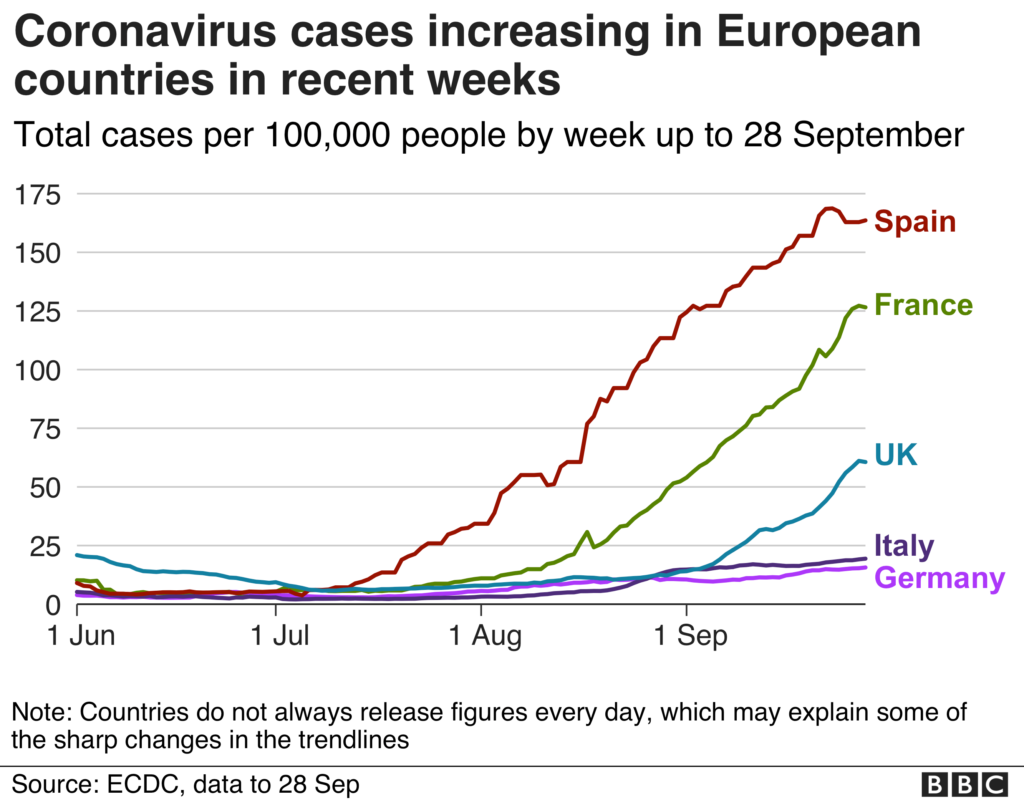
Italy’s cumulative number of Covid cases over the past two weeks is currently just over 37 per 100,000 people, among the lowest rates in Europe. The UK is at over 100, France exceeds 230 and Spain has around 330.
“February and March were very hard,” says Elisabetta Cortis, one of the paediatricians who founded the drive-through project. “And then we suffered a lot because with the lockdown, we had many problems for the kids. They stayed alone – no friends, no school, no sport, nothing.”
It is actually difficult to pinpoint exactly why Italy is somewhat bucking the trend of European countries experiencing an alarming spike in cases.
Its testing rate is not exceptionally high – the UK is carrying out over three times the tests of Italy – but the swabs are widely available and rapid testing is now in place at some airports, train stations and schools, so there is no sign of the problems in accessing tests that have been seen in the UK and elsewhere.
The most likely explanation is a combination of factors: efficient test and tracing, a longer lockdown – Italy was the world’s first country to shut down nationwide and among the slowest to reopen – and the fact that the trauma of the early weeks of the pandemic frightened Italians into widespread compliance with rules.
‘I feel much safer than in England’
At Tonarello, a pasta restaurant in the Roman district of Trastevere, several measures are in place, including plexiglass screens between tables, the recording of customers’ details for contact tracing and disposable paper menus. Some other restaurants and cafes use digital QR codes for menu access on smart phones.
All waiters wear masks and customers must do so when inside and not eating. It’s not unusual: mask-wearing has been scrupulous here since the start of the outbreak, compulsory inside and recently imposed in busy outdoor areas in some regions that have seen an increase in infections, such as Rome. Those breaking the rules on mask-wearing or large public gatherings face fines of up to €3,000 (£2,700).
The strict compliance has allowed restaurants to remain open and largely free of the early closures imposed in some other European countries. Many here have suffered financially from the lockdown – but Tonarello is busy.
Patrizia Corrias is enjoying lunch with her two daughters before they return to Britain where they’re at university.
“Here I feel much safer than in England,” she says. “I can see around that everyone is wearing masks and following rules, avoiding hugs for example.”
Why, I ask, does she feel the stereotype of obedient Brits and rebellious Italians has flipped?
“We were the first,” she says. “We had a very long quarantine and we really felt it. Many, many people were dying. And all those people dying alone – it was very strong.”
British exceptionalism
Prime Minister Boris Johnson recently evoked the issue of national character in parliament, when asked by a Labour MP whether he felt that better testing and tracing was why Italy and Germany were outperforming the UK in managing the virus.
“No I don’t,” he replied, adding that the difference between Britain and others is that “we are a freedom-loving country.”
That hasn’t gone down brilliantly here, where memories of Italy’s independence struggle and its fight for freedom from Nazi occupation still run deep.
“I can smile a bit at Boris Johnson’s comments,” says Pierpaolo Sileri, Italy’s deputy health minister.
“When you respect rules, there’s freedom. If we are free now to do the majority of things, it’s because we were very strict with the rules.”
Mr Sileri’s hint of alarm over the next few months comes partly from the fact that Italy was one of the slowest countries to reopen schools – and that only now is the hot summer beginning to break, the cold weather bringing with it the increased risk of contagion.
So it is possible that Italy, ahead of the rest of Europe when Covid arrived, is behind the curve as its neighbours struggle with a spike.
But for now the figures look promising. And that simple formula – tests, rules, compliance – will, this country hopes, halt a second wave and ease the legacy of pain from the first.
Source: https://www.bbc.com/news/world-europe-54356335